The Event:
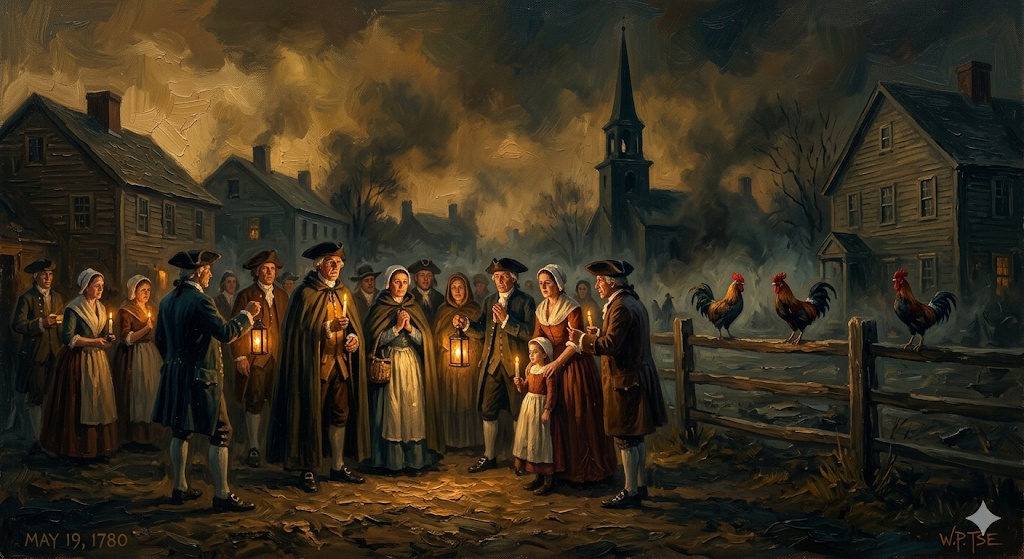
On May 19, 1780, a profound and terrifying environmental phenomenon known as New England’s Dark Day unfolded across the northeastern United States and parts of eastern Canada. Beginning around 10:30 AM, an inexplicable and complete darkness swept over the region, cloaking the midday landscape in an eerie, midnight gloom that required candles to be lit in households and businesses. The obscuration peaked in the early afternoon, causing roosters to crow, birds to return to their nests, and frogs to pipe as if night had prematurely fallen. Compounded by a heavy, soot-laden atmosphere and a deeply tinted yellow and red sky, the darkness persisted through the night and did not fully disperse until the following day.
The Impact:
The impact of the Dark Day was deeply psychological and cultural, occurring during the height of the American Revolutionary War and sparking widespread panic. With no scientific explanation available at the time, many citizens interpreted the event as a divine omen or the biblical Day of Judgment. In Hartford, Connecticut, the state legislature was pushed to the brink of panic, prompting Councilor Abraham Davenport to famously state that if the end of the world was coming, he preferred to be found doing his duty, successfully voting to keep the assembly in session. Centuries later, modern scientific analysis of tree rings and historical records determined that the event was actually caused by an immense, unprecedented wildfire in Ontario, Canada. The massive columns of smoke had mixed with dense fog and low-lying cloud cover, creating a historic atmospheric anomaly that remains a legendary piece of early American folklore.