
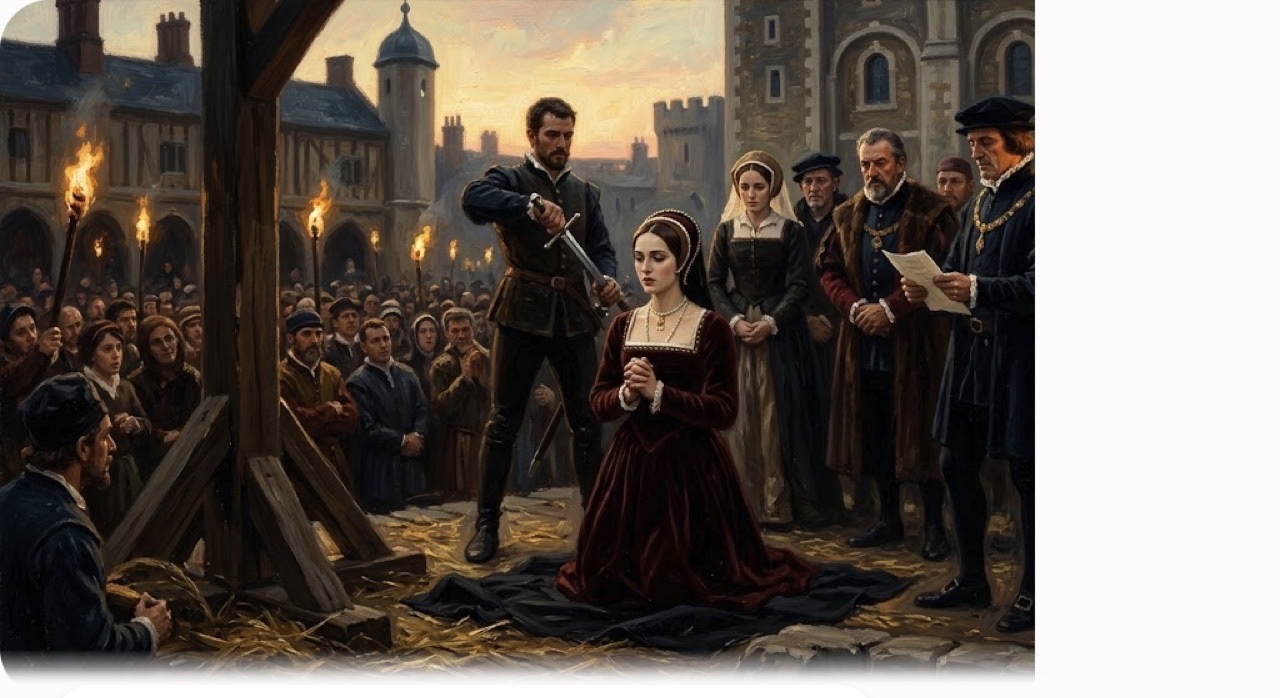
 On May 19, 1536, Anne Boleyn, the second wife of King Henry VIII and mother of the future Queen Elizabeth I, was executed by beheading on Tower Green within the walls of the Tower of London. Following her dynamic rise to power as the queen who had triggered England’s break from Rome, Anne was arrested on May 2 on charges of high treason, adultery, and incest. These allegations, widely believed by modern historians to have been manufactured by Henry and his chief minister Thomas Cromwell to remove her, were tried swiftly, resulting in her condemnation. Anne’s final act on the scaffold was to give a final, poised speech, a moment of profound public solemnity.
The impact of Anne Boleyn’s execution was transformative, permanently altering the religious, political, and cultural trajectory of England. The event cemented the English Reformation, as the break from the Roman Catholic Church—which had begun to enable Henry’s marriage to Anne—became irreversible. Politically, her downfall and the subsequent execution of her alleged co-conspirators served as a chilling display of raw monarchical power and the absolute precarity of political life under Henry VIII. Most significantly, her daughter, Elizabeth I, would ascend to the throne in 1558 and go on to become one of England’s most celebrated and powerful monarchs, defining a golden age. Today, Anne Boleyn remains an enduring, complex historical figure, a symbol of tragedy, resilience, and the relentless dynamics of absolute power.