
The Event:
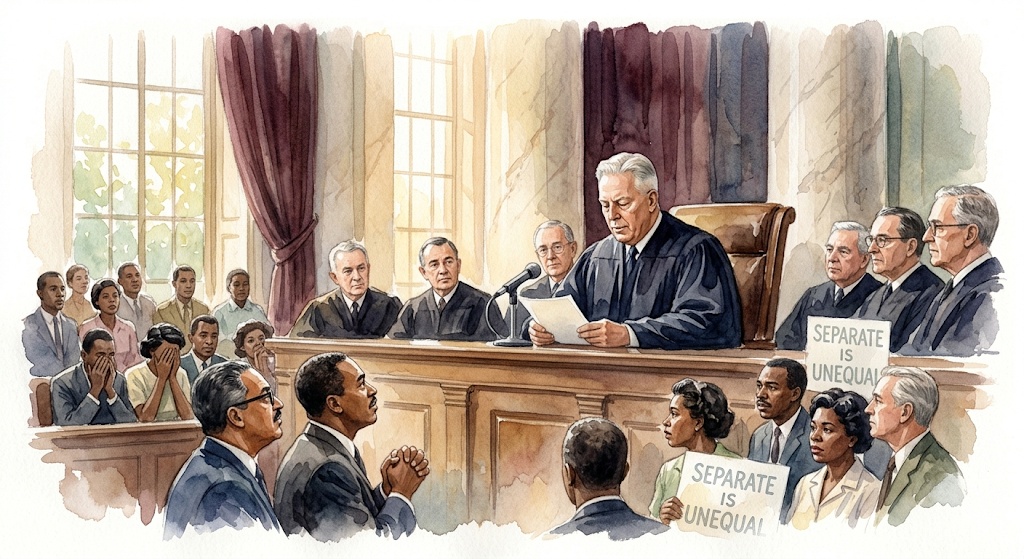
On May 17, 1954, the Supreme Court of the United States handed down a unanimous 9–0 decision in the landmark case Brown v. Board of Education of Topeka. Chief Justice Earl Warren delivered the court’s opinion, ruling that racial segregation in public schools was unconstitutional. The decision directly overturned the “separate but equal” doctrine established by the 1896 Plessy v. Ferguson case, with the Court declaring that “separate educational facilities are inherently unequal.” The ruling concluded that segregating children in public schools based solely on race violated the Equal Protection Clause of the Fourteenth Amendment, marking a monumental turning point in American legal history.
The Impact:
The impact of Brown v. Board of Education was profound and far-reaching, serving as a primary catalyst for the modern Civil Rights Movement. While the ruling did not instantly desegregate all American schools—and faced years of fierce “massive resistance” across the South—it provided a critical legal precedent that dismantled the institutional foundations of Jim Crow segregation. The victory energized civil rights activists, paving the way for future legal challenges, boycotts, and marches, and ultimately leading to the passage of the Civil Rights Act of 1964 and the Voting Rights Act of 1965. It stands today as one of the most significant Supreme Court decisions in history, fundamentally reshaping the social, legal, and moral fabric of the United States.