
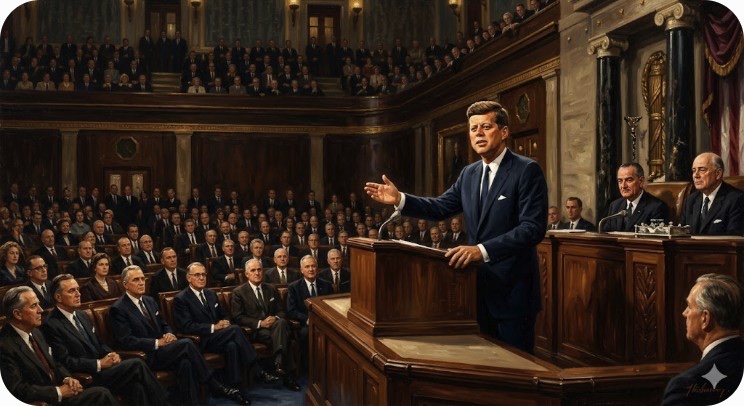
The Event:
On May 25, 1961, President John F. Kennedy delivered a historic address before a joint session of Congress that completely reframed the Cold War. In his speech, titled the “Special Message to the Congress on Urgent National Needs,” Kennedy famously issued a bold, unprecedented challenge to the nation: landing a man on the Moon and returning him safely to the Earth before the decade was out. At the time, the United States was reeling from a series of strategic setbacks, including the Soviet Union’s successful launch of Yuri Gagarin into space just a month prior and the recent failure of the Bay of Pigs invasion. Kennedy’s speech was a massive political and technological gamble, as NASA had only logged 15 minutes of suborbital human spaceflight with Alan Shepard’s Mercury mission.
The Impact:
Kennedy’s declaration fundamentally altered global geopolitics, accelerated technological innovation, and led to one of the greatest achievements in human history. The speech galvanized the American public and political infrastructure, shifting the Space Race into maximum gear. It triggered a massive mobilization of national resources, prompting Congress to immediately increase NASA’s budget by over 50%. At its peak, the Apollo program employed over 400,000 scientists, engineers, and technicians, consuming over 4% of the total federal budget. The rigorous demands of the lunar objective sparked rapid advancements in computing, telecommunications, material sciences, and systems engineering. Technologies developed for Apollo—from integrated circuits to advanced water purification—laid the groundwork for the modern digital and tech-driven economy. The ambitious goal was ultimately realized on July 20, 1969, when Neil Armstrong and Buzz Aldrin stepped onto the lunar surface during the Apollo 11 mission. Kennedy’s vision transformed space exploration from a series of incremental military-focused milestones into a unified, historic leap for all humankind.