
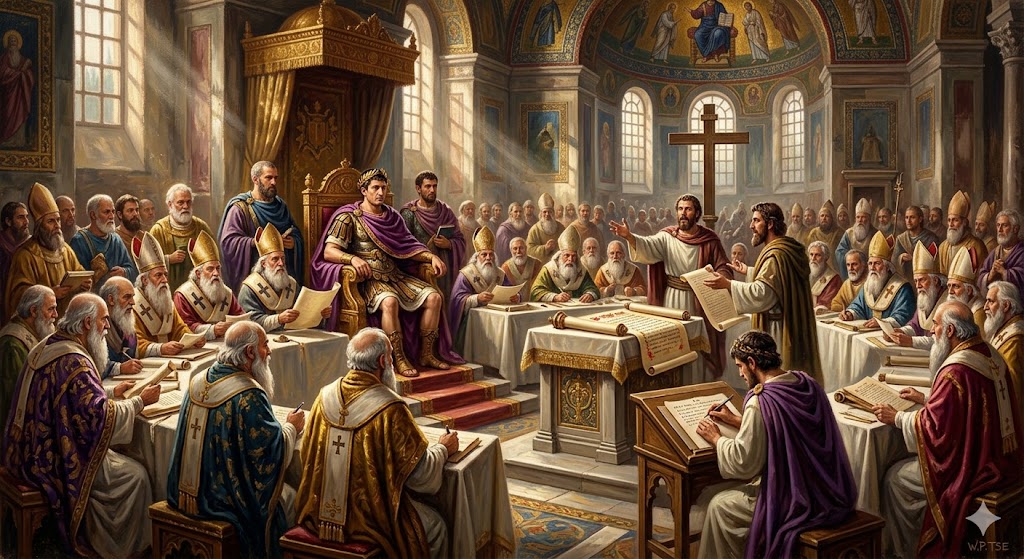
The Event:
Convened by the Roman Emperor Constantine I, the First Council of Nicaea brought together roughly 318 Christian bishops from across the Roman Empire to the city of Nicaea (modern-day İznik, Turkey). The primary objective was to resolve the theological crisis of Arianism—a doctrine proposed by Arius of Alexandria who argued that Jesus Christ was a created being and not co-eternal with God the Father. In the chamber, bishops and theologians debated the nature of the divine, referencing sacred scriptural scrolls arrayed on a central altar beneath a large cross.
The Impact:
The First Council of Nicaea fundamentally shaped the theological and political trajectory of Western civilization. The council overwhelmingly rejected Arianism and drafted the original Nicene Creed, establishing the orthodox Christian doctrine of the Trinity by defining Jesus as being of the exact same substance (homoousios) as the Father. It marked the first time an emperor intervened in church affairs to enforce theological unity, establishing a precedent for state-sanctioned religion that would define European geopolitics for over a millennium. Beyond theology, the council standardized major structural traditions within the early Church, including a uniform method for calculating the annual date of Easter and securing the legal organizational hierarchy of provincial bishops.