
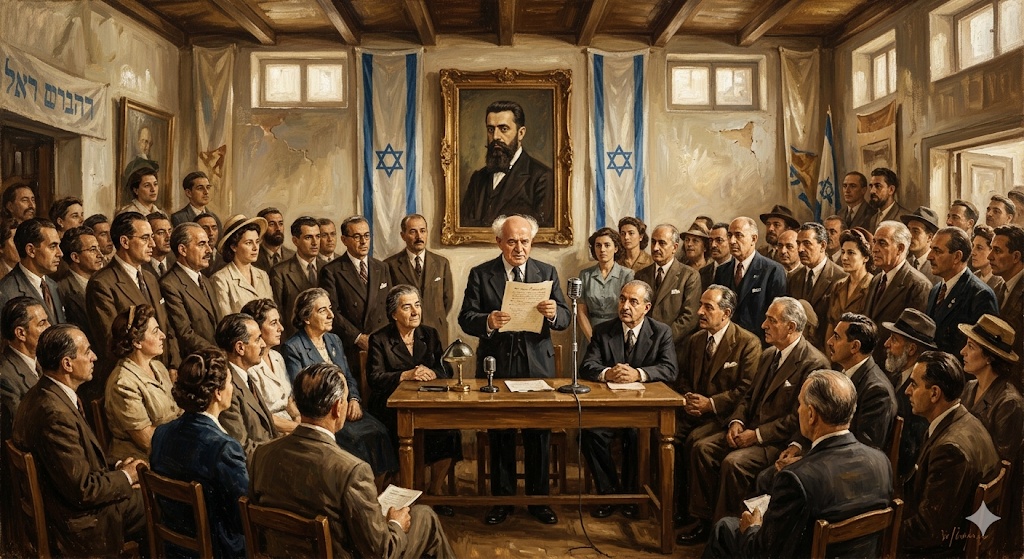
 On May 14, 1948, David Ben-Gurion, the executive head of the World Zionist Organization, officially proclaimed the establishment of the State of Israel. The historic ceremony took place at the Tel Aviv Museum (now Independence Hall) just hours before the British Mandate for Palestine was set to expire at midnight. Amidst the ticking clock of history and the impending withdrawal of British forces, the Declaration of the Establishment of the State of Israel was read to a small, invited audience of the People’s Council. This moment represented the culmination of decades of Zionist efforts to establish a Jewish homeland and occurred against a backdrop of intense regional tension and the immediate outbreak of the 1948 Arab–Israeli War.
The impact of Israel’s declaration was profound and permanent, fundamentally altering the geopolitical landscape of the Middle East. Internationally, it led to immediate recognition by world powers, with the United States extending formal recognition just 11 minutes after the proclamation, followed by the Soviet Union three days later. For the Jewish people, it provided a sovereign refuge following the horrors of the Holocaust, leading to waves of immigration that doubled the Jewish population within a few years. Conversely, the event is viewed by Palestinians as the start of the Nakba (Catastrophe), marking mass displacements and a refugee crisis that remains central to global politics today. The establishment of the state set the stage for decades of conflict, diplomacy, and the ongoing struggle for peace in the region.