
The Event:
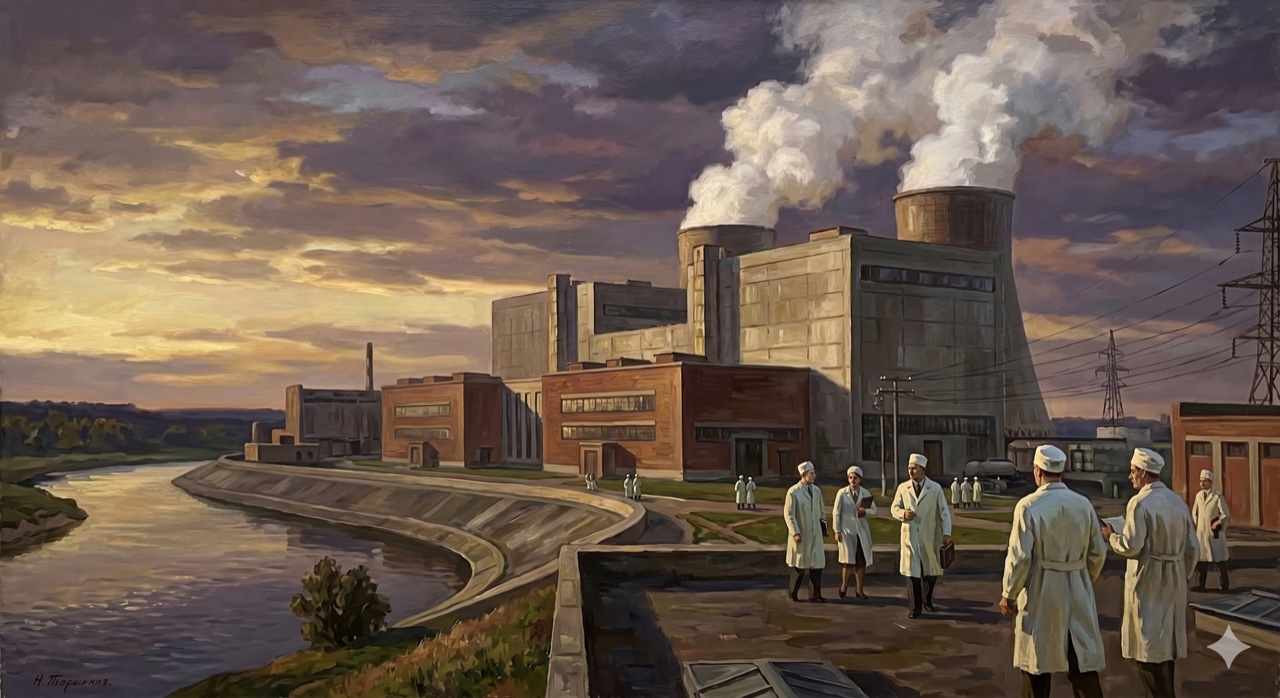
On April 26, 1954, the Obninsk Nuclear Power Plant, located in the Soviet Union (present-day Russia), became the world’s first nuclear power plant to generate electricity for a power grid. While experimental reactors had previously produced electricity, Obninsk was the first designed as a commercial facility, successfully connecting to the local grid and delivering power. The realistic oil painting visualizes the massive, blocky concrete and brick industrial structure, typical of Soviet design, situated along the Protva River. Billowing white steam plumes erupt from the large cooling stacks against a dramatic, cloudy sunset sky. In the foreground, specialized scientists and engineers, identifiable by their light lab coats and caps, are seen moving across the plant’s grounds, highlighting the intense human effort and pioneering scientific achievement.
The Impact:
The successful operation of the Obninsk plant was a watershed moment, demonstrating that the immense energy bound within the atom could be harnessed for peaceful, civilian purposes. It fueled the global race for nuclear energy development, inspiring rapid advancements in the United States, United Kingdom, and beyond. This milestone established the technological and operational feasibility of a power source that, while complex and controversial, continues to be a significant component of the global energy mix, promising low-carbon electricity on a massive scale and serving as a testament to the transformative power of 20th-century scientific engineering.