The Event:
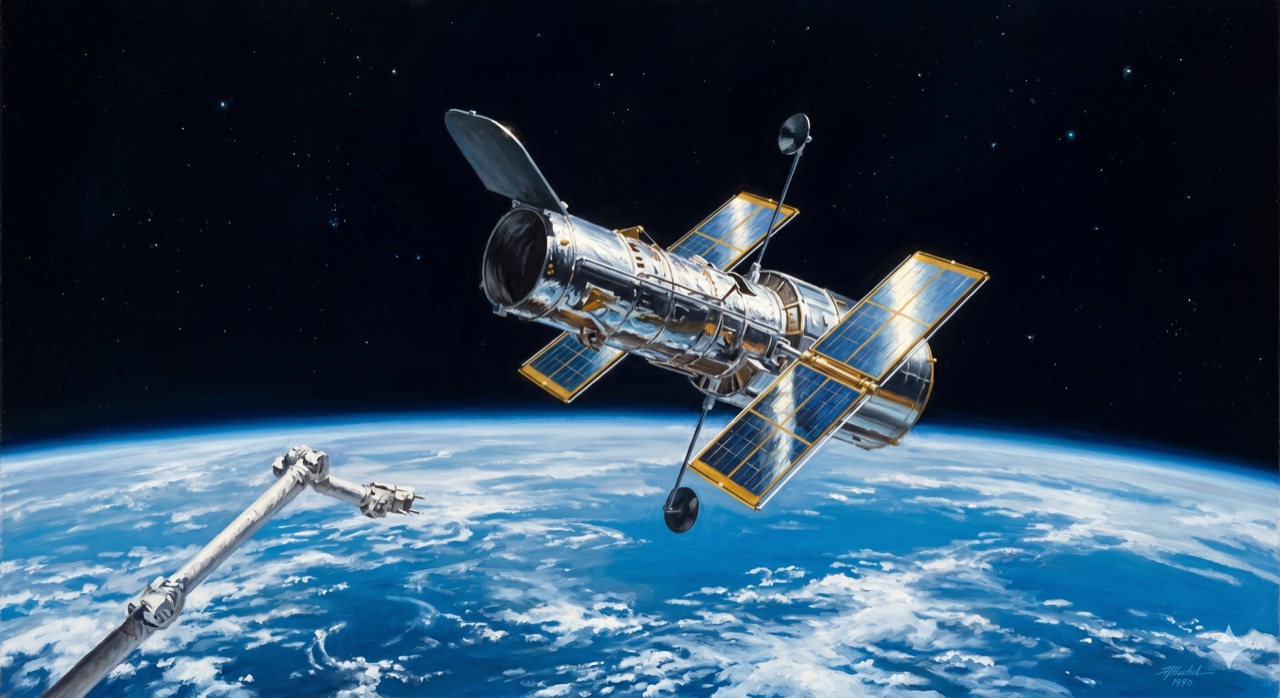
On April 25, 1990, the day after its launch aboard the Space Shuttle Discovery (STS-31), the Hubble Space Telescope (HST) was deployed into low Earth orbit. This crucial operational moment marked the true beginning of the observatory’s mission. After the shuttle’s cargo bay doors opened, the remote manipulator system arm gently lifted the school bus-sized telescope. The visualization captures the precise moment the HST was released: it floats serenely against the profound, deep blackness of space, illuminated by dynamic Earthshine. Bright white, gold, and azure blue washes define the reflective surfaces of the telescope and its newly unfurled solar arrays. Far below, a dramatic, swirling marble of blue oceans and white cloud formations covers the curvature of the Earth, providing a spectacular, silent contrast.
The Impact:
The deployment of Hubble, despite an initial, devastating flaw in its primary mirror (later corrected in 1993), fundamentally revolutionized astronomy. By operating above the distorting effects of Earth’s atmosphere, HST provided unprecedentedly clear views of the universe. It enabled astronomers to calculate the age of the cosmos precisely, prove the existence of supermassive black holes, and capture the “Deep Field” images, revealing thousands of galaxies in seemingly empty patches of sky. Culturally, Hubble’s breathtaking images of nebulae, star clusters, and distant galaxies transformed humanity’s visual relationship with the cosmos, inspiring generations and cementing its legacy as one of the most productive scientific instruments ever built.