
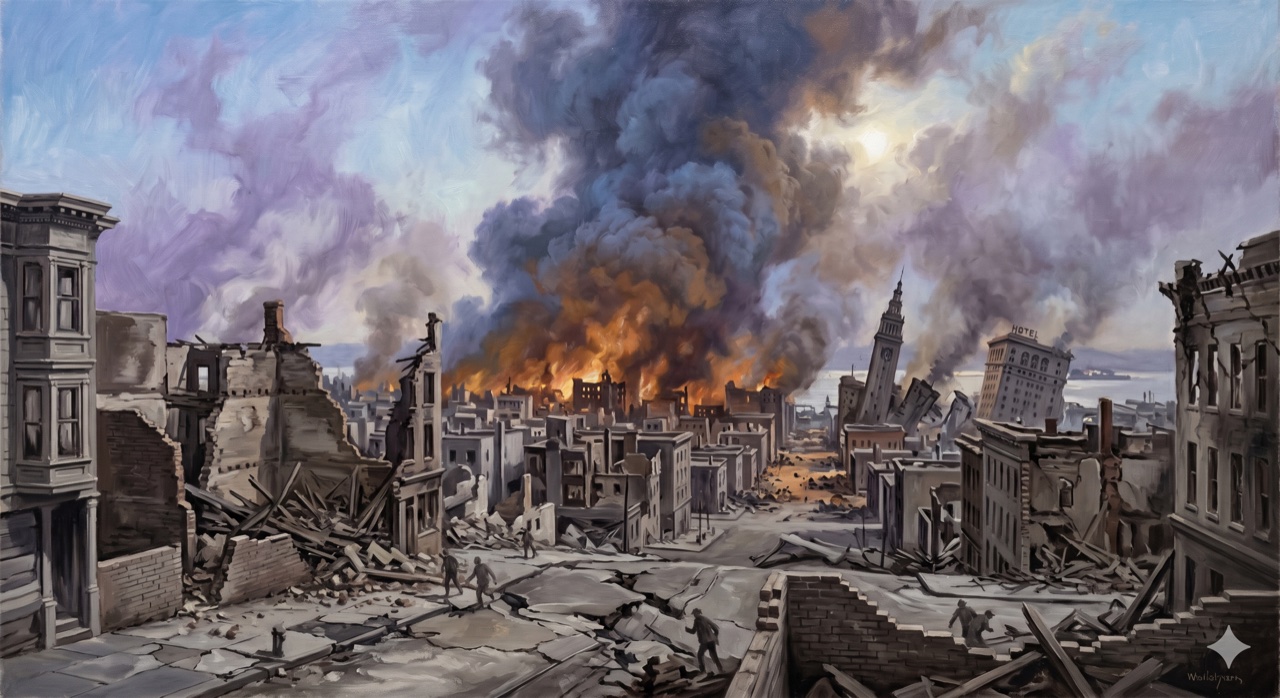
On the morning of April 18, 1906, at approximately 5:12 a.m., a powerful, magnitude 7.9 earthquake, centered near San Francisco along the San Andreas Fault, struck the coast of Northern California. While the violent initial shaking caused significant damage—flattening Victorian buildings, fracturing roads, and toppling famous structures like the Flood Mansion—the event is infamous for the subsequent catastrophes. The seismic activity instantly severed the city’s water lines, making standard firefighting impossible when numerous gas lines ignited. A watercolor painting, rendered on rough paper, visualizes the view from Nob Hill looking east towards the burning downtown. In the foreground, shattered pavements and broken walls are rendered with gray and sepia washes. Plumes of dramatic, smoke-filled indigo and gray watercolor bleed together across the midground, illuminated by soft orange, yellow, and red fire washes where the city’s heart is consumed. Faint, silhouetted figures move over the rubble, their forms defined by delicate watercolor outlines against the chaotic, destructive scene.
The 1906 earthquake remains one of the most devastating natural disasters in United States history. In the four days that the resulting fires raged, nearly 80% of San Francisco was destroyed, rendering over half the population, approximately 250,000 people, homeless. The death toll is estimated to be over 3,000, and the financial impact exceeded $400 million (in 1906 dollars). This tragedy forces a pivotal moment of scientific inquiry, as researchers began to study the mechanics of fault lines, leading to the development of modern seismology and the theory of elastic rebound. Culturally, the city’s eventual complete reconstruction became a powerful symbol of resilience and determination, as San Francisco rebuilt with strongermaterials, wider streets, and a new understanding of urban planning in a seismic zone, establishing the foundation for the metropolis we know today.