
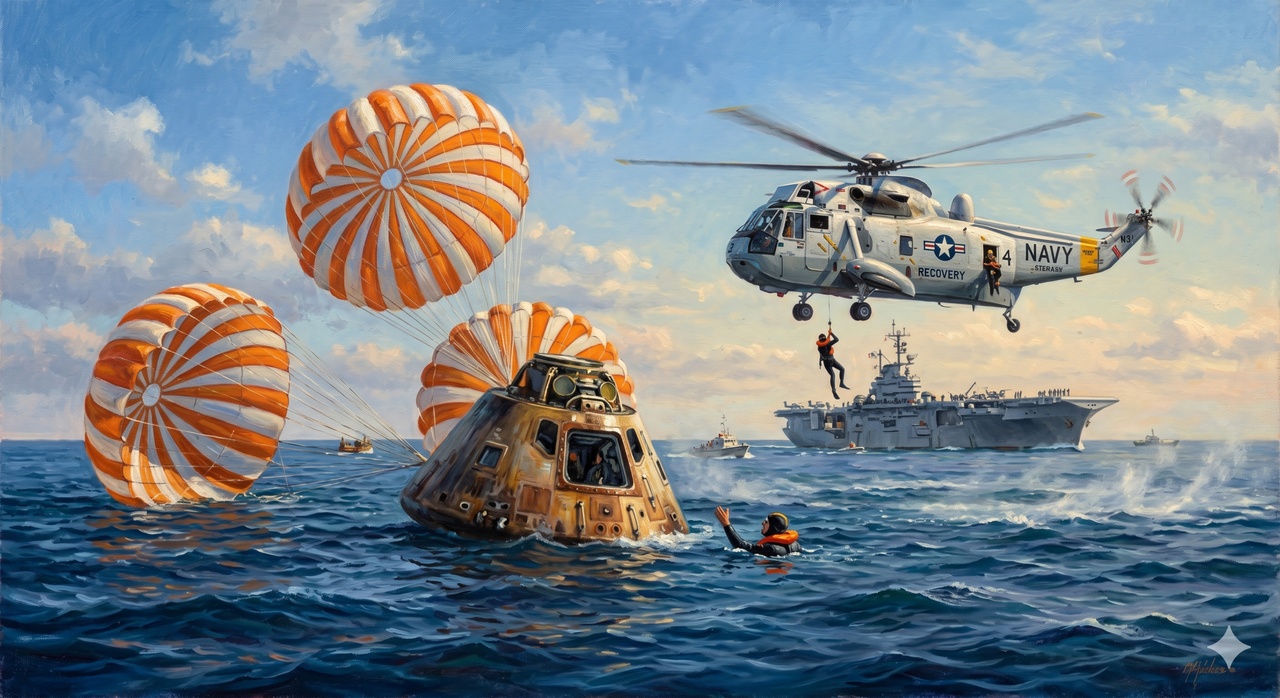
The Event: On April 17, 1970, the world breathed a collective sigh of relief as the Apollo 13 mission concluded with a successful splashdown in the South Pacific Ocean. What was intended to be the third lunar landing turned into a desperate struggle for survival after an oxygen tank exploded two days into the flight, crippling the Command Module “Odyssey.” For four days, astronauts Jim Lovell, Jack Swigert, and Fred Haise—supported by the tireless ingenuity of Mission Control—navigated a series of life-threatening obstacles. The mission’s climax saw the charred capsule plummet through the atmosphere, its three main parachutes unfurling against the bright blue sky before it bobbed safely in the ocean near the recovery ship, the USS Iwo Jima.
The Impact: Often called a “successful failure,” Apollo 13 became a testament to human resilience and the power of collaborative problem-solving under extreme pressure. While the mission failed to reach the lunar surface, the safe return of the crew was hailed as a triumph of NASA’s engineering and crisis management. It forced a critical re-evaluation of spacecraft safety and design, leading to significant improvements for subsequent Apollo missions. Culturally, it solidified the image of the astronaut as a figure of cool-headed bravery and reminded a world that had grown somewhat complacent about moon voyages just how thin the margin for error truly is in the vacuum of space.