
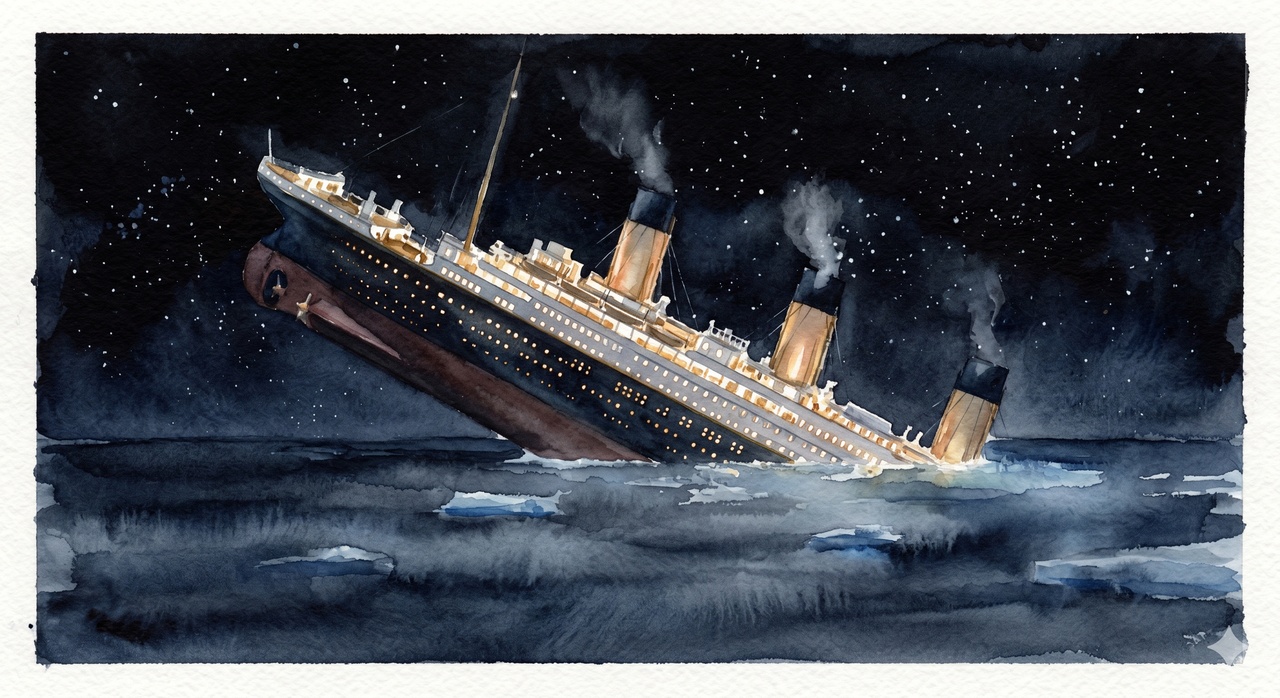
The Event: In the early hours of April 15, 1912, the RMS Titanic, the largest and most luxurious ocean liner of its time, sank in the North Atlantic Ocean after striking an iceberg during its maiden voyage. Despite being touted as “unsinkable,” the ship lacked sufficient lifeboats for all passengers and crew. This water color rendering captures the harrowing contrast of the scene: the massive, brightly lit vessel tilted at a steep angle against the absolute blackness of the freezing sea. Soft washes of deep indigo and Payne’s grey illustrate the mirror-calm, icy water, while delicate strokes of warm gold and white highlight the glowing portholes and the steam venting from the funnels. Over 1,500 souls were lost as the “Ship of Dreams” disappeared beneath a sky filled with indifferent starlight.
The Impact: The disaster of the Titanic fundamentally changed maritime law and safety forever. The global shock led to the first International Convention for the Safety of Life at Sea (SOLAS) in 1914, which mandated enough lifeboats for everyone on board, continuous radio watches, and the establishment of the International Ice Patrol. Beyond safety regulations, the sinking became a powerful cultural metaphor for the end of the Edwardian era’s blind faith in technological progress and social class rigidity. It remains the most famous maritime tragedy in history, a haunting reminder of human fallibility and the unforgiving power of nature.