
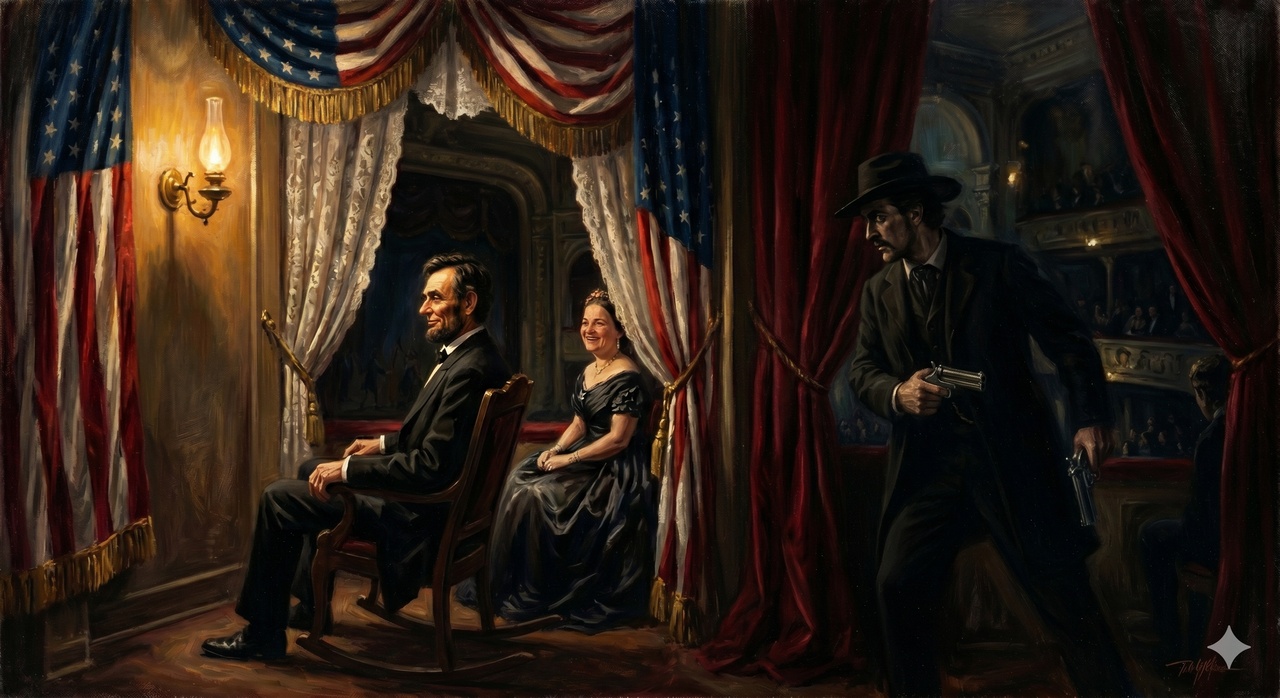
The Event: On the evening of April 14, 1865—just days after the surrender of Confederate General Robert E. Lee—President Abraham Lincoln was assassinated at Ford’s Theatre in Washington, D.C. While watching the play Our American Cousin, Lincoln was shot by John Wilkes Booth, a well-known actor and Confederate sympathizer. The attack was part of a broader conspiracy to decapitate the Union government and revive the Southern cause. In the chaotic aftermath, the President was carried to the Petersen House across the street, where he succumbed to his wounds early the following morning. The event transformed a night of national celebration into one of profound grief and uncertainty.
The Impact: The assassination of Abraham Lincoln had a catastrophic impact on the Reconstruction era. Lincoln had advocated for a “charitable” peace to reintegrate the Southern states, but his death left the nation in the hands of Andrew Johnson, whose tumultuous presidency led to bitter conflicts over civil rights and the treatment of the former Confederacy. Lincoln’s martyrdom cemented his legacy as the “Great Emancipator” and the savior of the Union, but it also stalled the progress of racial equality for decades. The tragedy remains a defining moment in American history, representing the deep-seated divisions that persisted even after the guns of the Civil War had fallen silent.