
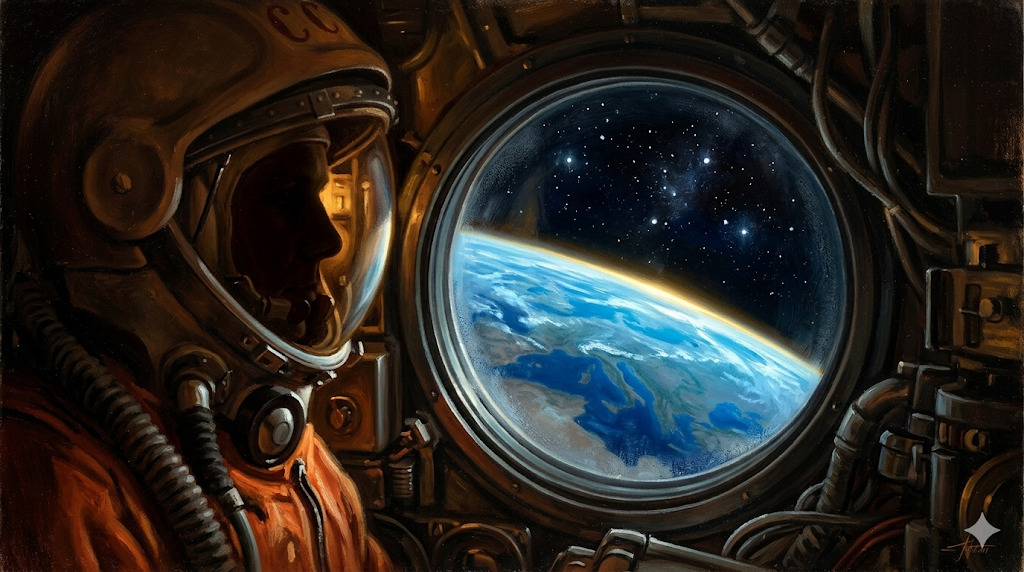
The Event: On April 12, 1961, Soviet cosmonaut Yuri Gagarin became the first human to travel into outer space, a milestone achieved by the Vostok 1 mission. This vertical oil painting visualizes Gagarin looking out a small viewport from Earth orbit. Rendered in a somber, realistic style, the composition emphasizes the profound isolation and awe of the moment. Gagarin is shown wearing his orange pressure suit and heavy helmet, his face silhouetted against the internal cabin lights. He is focused intently on the thick glass, which frames the dramatic, curved blue marble of the Earth below. Golden sunlight catches the edge of the planet’s atmosphere, separating the azure surface from the infinite black abyss of deep space. The view captures the stark transition between the fragile blue horizon and the absolute void beyond, defining the boundary of human experience.
The Impact: Gagarin’s single 108-minute orbit was a defining moment of the 20th century. It validated centuries of scientific theory and human curiosity, demonstrating that people could survive and operate in space. By initiating the era of human spaceflight, Vostok 1 intensified the Space Race, leading directly to the United States’ commitment to land a man on the Moon. Beyond the Cold War rivalry, the mission cemented April 12th as the “dawn of the space age.” Gagarin himself became an enduring global icon of peace and technical achievement, proving that Earth was a solitary, fragile planet when viewed from above. Today, his flight is celebrated as a shared victory for all mankind, inspiring generations of scientists, explorers, and artists to continue pushing the limits of human understanding.