
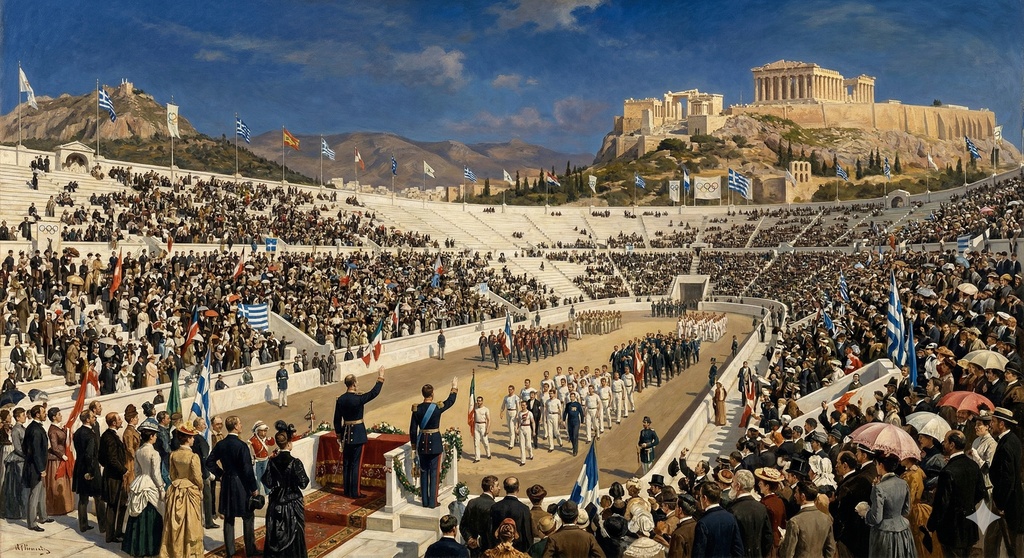
The Event: This painting, rendered in a classical oil style with a golden warmth fitting for Greece, depicts the opening ceremony of the first modern Olympic Games at the Panathenaic Stadium in Athens on April 6, 1896. From a high perspective, we look down into the ancient marble structure, packed with nearly 80,000 spectators, all dressed in late 19th-century attire. Below, a column of international athletes, organized by nation and carrying early versions of their flags, marches toward the Royal Box. At that very moment, King George I of Greece, standing beneath a massive Greek flag, is captured announcing the official opening of the Games with an outstretched arm. In the distance, rising high above the stadium, the iconic columns of the Acropolis and the Parthenon stand against a deep blue sky, visually connecting the new era of global competition directly to its ancient cultural source.
The Impact: The 1896 Athens Games were a profound symbol of cultural and geopolitical transformation. Spearheaded by Pierre de Coubertin, the modern Olympic movement was intended to promote global peace, mutual respect, and international understanding through athletic competition—a direct rebuke of rising industrial-age nationalism. By anchoring the rebirth in Athens, the event provided a bridge between the ancient Greek ideals of Arete (virtue or excellence) and the emerging global community. The success of these Games, despite numerous political and logistical hurdles, laid the foundational legitimacy for the Olympic movement. Today, the 1896 Games are recognized as a defining moment in global sports history, establishing a biennial (now seasonal) ritual that unites the entire planet in competition and cooperation, making the modern Olympics one of the few truly shared global cultural events.