
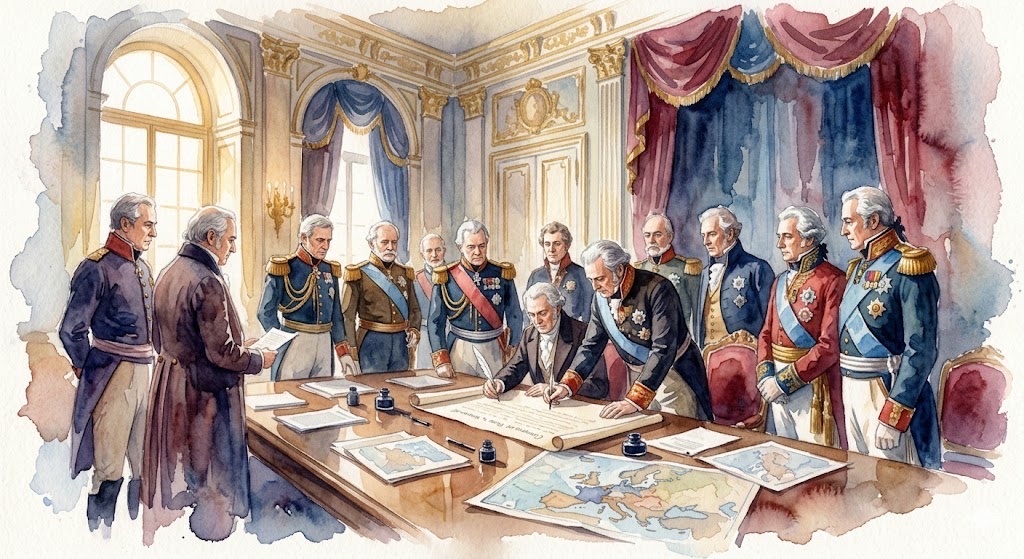
The Event
On June 9, 1815, the final acts of the Congress of Vienna were signed, formally concluding a diplomatic conference that had convened since September 1814. After Napoleon’s final defeat, the remaining European powers—principally Austria, Great Britain, Prussia, Russia, and France—convened to redraw the political map of Europe and restore stability after the Napoleonic Wars and French Revolutionary Wars. The Congress established territorial settlements and a new structure of European diplomacy that would endure for decades.
The Impact
The Congress of Vienna reshaped Europe through several lasting mechanisms. It created a new geopolitical framework based on the principle of a “balance of power,” ensuring no single nation could dominate the continent as Napoleonic France had, contributing to a remarkably long period of relative peace in Europe. It restored many monarchs and dynasties deposed by Napoleon, redrew borders creating new entities like the German Confederation, and established the precedent of multilateral diplomacy among great powers—the Concert of Europe, a distant precursor to the League of Nations and the United Nations.