
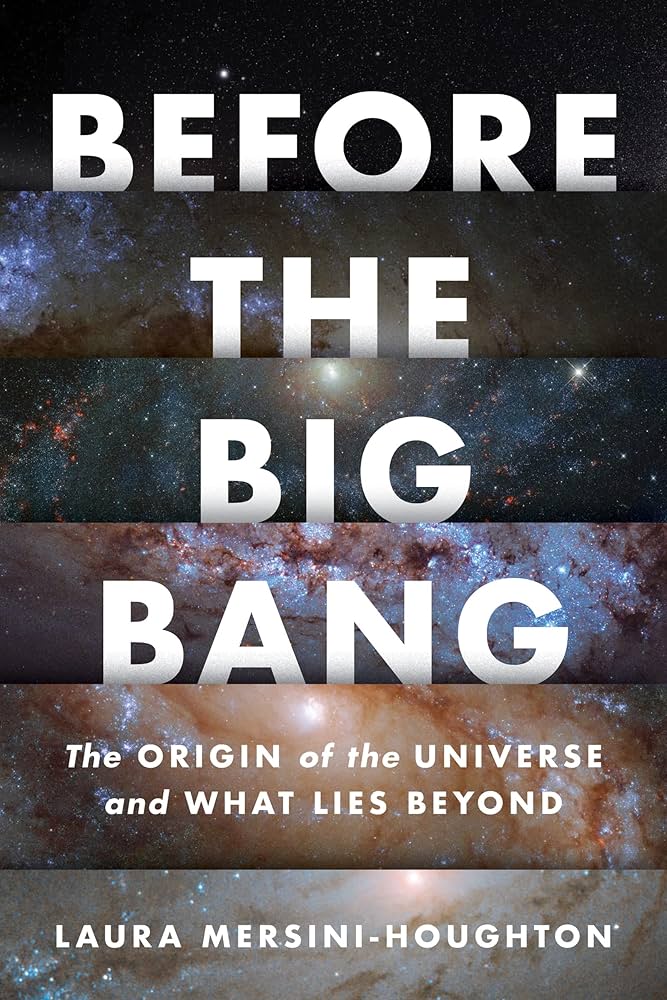
Prologue: My Albanian Universe
Mersini-Houghton frames her scientific quest in the stark contrast between a repressive, isolated Albania and the limitless sky she could only glimpse through books, music and her father’s encouragement. Her family’s persecution—exile, imprisonment and the disappearance of a relative’s body—instilled a fierce curiosity and a resolve to seek “the mathematical beauty of the universe.” The personal narrative becomes a metaphor for humanity’s desire to look beyond imposed borders, setting up the central question of the book: why does the universe exist at all, and what lies beyond its apparent edge?
Chapter 1: Is Our Universe Special?
The author recounts her path from a Fulbright scholarship to graduate work in the United States, where she encounters a startling calculation by Roger Penrose: the probability of a universe forming with the low-entropy conditions required for a Big Bang is approximately 1 in 10^(10^123). Penrose’s singularity theorem (with Hawking) implies that a universe beginning from a point of infinite density cannot be probed, making its origin seem uniquely improbable. Mersini-Houghton explains how this paradox, rooted in the second law of thermodynamics and Boltzmann’s entropy-probability relation, forces physicists to ask whether our cosmos is a rare cosmic lottery or a member of a larger ensemble.
Chapter 2: How Did Our Universe Start?
Historical development of cosmology is traced from early 20th-century ideas (Friedmann, Lemaître, Gamow) to the modern inflationary paradigm. Inflation solves the flatness, homogeneity and horizon problems by positing a brief era of exponential expansion driven by a slowly-rolling “inflaton” field with vacuum-like negative pressure. Yet the inflaton’s low-entropy initial state reproduces Penrose’s improbability: the universe must start in an exquisitely ordered patch (near the Planck length). The author highlights the tension between inflation’s empirical success and its reliance on an unnatural, finely-tuned beginning, motivating the search for a deeper origin theory.
Chapter 3: A Quantum Leap
Mersini-Houghton argues that the answer to the origin problem lies in quantum mechanics. She reviews the rise of quantum theory—from Planck’s quantized energy and wave-particle duality to Heisenberg’s uncertainty principle and Schrödinger’s wave equation—emphasizing that any infant universe is a quantum object described by a wavefunction with many possible “branches.” The chapter critiques the Copenhagen “collapse” view (Bohr, Heisenberg) as an ad-hoc observer-dependent fix, and uses the Schrödinger-cat paradox to illustrate why a single, deterministic universe is philosophically untenable. The multiplicity of quantum histories suggests a natural arena for a multiverse of possible universes.
Chapter 4: Fine-Tuning
The discussion turns to the precise amount of inflationary perturbations and dark-energy density required for a habitable cosmos. The author shows that cosmic inflation, while matching observations, demands an initial inflaton potential that is incredibly fine-tuned; any deviation would yield a universe either collapsing quickly or remaining empty. This “fine-tuning” mirrors the low-entropy, low-probability start identified by Penrose, and even leads to paradoxes such as the Boltzmann-brain problem. Mersini-Houghton concludes that acknowledging a multiverse—where many inflaton potentials arise with varying probabilities—offers a plausible resolution to the fine-tuning puzzle and paves the way for testable predictions about other universes.
Chapter 5: Are We Alone?
The author interweaves personal history with scientific history, using her father’s persecution in Albania as a metaphor for intellectual exile. She critiques Bohr’s wave function collapse for creating a “double standard” between classical observers and quantum systems. Schrödinger’s cat paradox becomes her vehicle to expose the absurdity of observer-dependent reality. Everett’s many-worlds interpretation emerges as a natural consequence of applying quantum rules consistently to everything, including observers. Mersini-Houghton highlights the personal cost of this insight—Everett’s career destruction—and praises DeWitt’s courage in publishing it. She frames the multiverse not as speculation but as the mathematical outcome of quantum mechanics applied to cosmology.
Chapter 6: Eleven Dimensions
Mersini-Houghton introduces string theory as the promising “theory of everything,” explaining how vibrating strings replace point particles at Planck scales. The mathematical requirement of eleven dimensions—seven hidden and compactified—is detailed through accessible analogies with art and perspective. The devastating twist: compactification produces not one universe but 10^500 possible vacua, the “landscape.” Rather than despairing, the author celebrates this as “the best possible news”—the third time physics points to a multiverse. She contrasts her enthusiasm with string theorists’ crisis, showing how their mathematical reduction from eleven dimensions inadvertently became a “universe-making factory.” The chapter transforms catastrophe into opportunity.
Chapter 7: First Wave
Arriving at UNC Chapel Hill in 2004, the author makes the risky career choice to investigate cosmic origins before tenure. She confronts the speed-of-light barrier that makes multiverse observation seemingly impossible. The breakthrough comes in a Chapel Hill coffee shop: “quantum mechanics on the landscape.” By treating the infant universe as a wave packet propagating through string theory’s energy landscape, she can apply the Wheeler-DeWitt equation to determine which vacua produce universes. Like electrons in a disordered wire getting trapped by impurities, wave-universes localize in landscape valleys. This physical mechanism connects abstract mathematical spaces to observable reality, enabling the first testable multiverse theory.
Chapter 8: Into the Multiverse
The mathematical details reveal the quantum landscape multiverse theory. The wave function’s branches settle in different landscape vacua, each with different energies driving inflation. Initial calculations frustratingly reproduce the old problem—low-energy universes seem most probable. The missing ingredient is decoherence: the process by which entangled quantum branches decouple to become classical, independent universes. Including quantum fluctuations as a “bath” that triggers decoherence reverses the odds—high-energy universes like ours become the most probable. The author completes her theory by proposing testable predictions: entanglement should leave “scars” or “birthmarks” on the cosmic microwave background.
Chapter 9: The Origin of Our Universe
Mersini-Houghton first dismantles the anthropic principle, collaborating with Fred Adams to show that habitable universes could exist across a vast range of physical constants—indeed, many configurations are more habitable than ours. She argues that invoking an observer-dependent origin “was like throwing in the towel on science.” The chapter then pivots to the central challenge: testing the multiverse. Rejecting the dogma that it is untestable, she proposes that quantum entanglement left detectable “scars” on our universe during its infancy. By applying the principle of unitarity—information conservation in quantum mechanics—she argues that signatures of entanglement with sister universes were stamped onto the cosmic microwave background (CMB). Her team calculated these non-uniform anomalies, creating a “road map to the multiverse” in the sky.
Chapter 10: Fingerprints of Other Universes
This chapter details the validation of the author’s theory. Upon publishing their 2005 paper “Avatars of the Landscape,” the team nervously awaited observational confirmation, which arrived when radio astronomers and later the Planck satellite identified the predicted Giant Void (the “Cold Spot”) and a hemispheric asymmetry. The author emphasizes the significance of pre-prediction: these anomalies violate the uniformity of single-universe inflation and require a second source. She addresses “cosmic variance”—the statistical limitation of having only one universe to measure—but contends that six of seven predictions were confirmed, including the absence of low-energy supersymmetry. She argues that this consistent, retroactive explanatory power makes the multiverse theory highly persuasive.
Chapter 11: Infinity and Eternity
The author surveys the multiverse landscape, noting that even Roger Penrose developed a “sequential aeon” model that inadvertently produces a temporal multiverse. She recounts a vibrant dinner debate with Penrose at a Chapel Hill restaurant, where they discovered their models—his in time, hers in space—were complementary. She critiques eternal inflation, noting that it pushes origins into an untraceable infinite past like a “leaf on an infinitely old tree.” Her own work with Malcolm Perry demonstrates that eternal inflation must eventually cease as space-time becomes too “choppy.” She frames this as a paradigm shift extending the Copernican principle, where a multiverse is no longer fringe but the most coherent framework for cosmic origins.
Epilogue: A Place to Dream
The Epilogue frames scientific discovery as an act of courageous departure from established theory, paralleling the quantum revolution with the current multiverse paradigm. Mersini-Houghton traces the intellectual lineage from Democritus’s atomic multiverse and Epicurus’s “swerve” (anticipating quantum indeterminism by millennia) through the clashes of Plato, Aristotle, and Newton, to Einstein’s relativistic cosmos. She reflects on her childhood in Communist Albania, where her father instilled in her the value of knowledge. The chapter concludes that a multiverse does not end inquiry but expands it, offering a “glimpse of the cosmos beyond our horizon and before the Big Bang” and freeing scientific imagination from the limits of a single universe.