The Event:
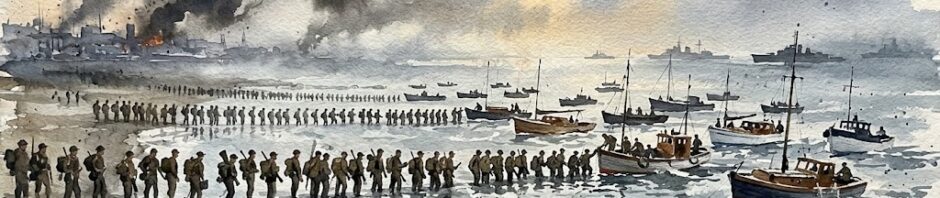
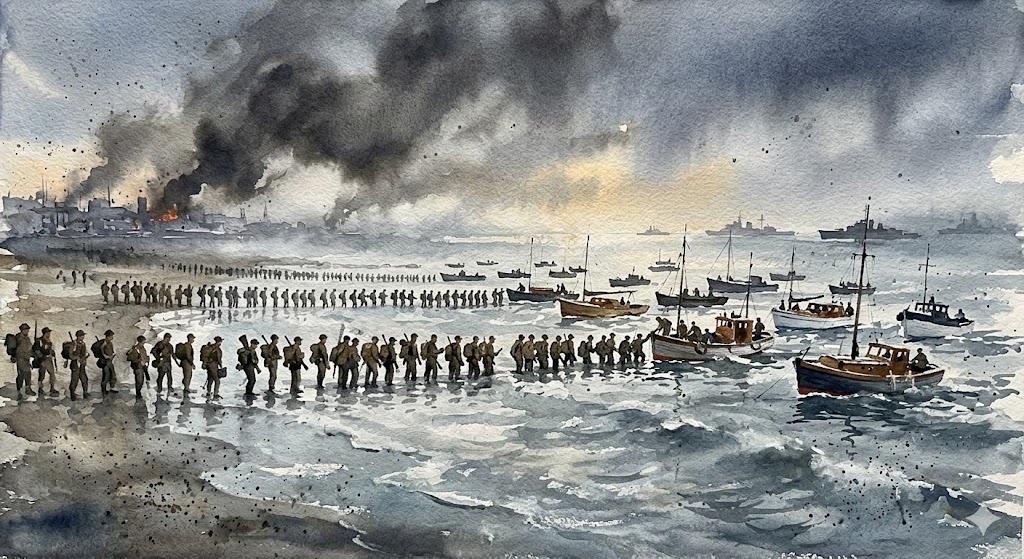
On June 4, 1940, one of the most critical logistical achievements and morale-boosting turning points of World War II concluded: the Dunkirk evacuation (Operation Dynamo). Following the lightning-fast German invasion of France, the British Expeditionary Force (BEF) along with large remnants of the French and Belgian armies found themselves completely cut off, surrounded, and backed against the sea in the northern French port town of Dunkirk. With the German forces closing in, a total military catastrophe seemed inevitable, threatening to eliminate Great Britain’s entire trained regular army in a single blow. In a desperate bid to rescue the stranded troops, the British Admiralty mobilized a makeshift armada. Over the course of nine days, more than 800 vessels took part in the evacuation. This fleet included naval destroyers and merchant ships, but most famously a massive collection of civilian craft—fishing boats, pleasure yachts, lifeboats, and harbor tugs later immortalized as the “Little Ships of Dunkirk.” Braving continuous bombardment and strafing by the German Luftwaffe, these vessels evacuated a staggering 338,226 Allied soldiers from the harbor’s concrete mole and directly off the shallow beaches.
The Impact:
The successful conclusion of the evacuation fundamentally shifted the political and strategic reality of World War II. While the British Army left behind virtually all of its heavy artillery, tanks, and vehicles on the beaches of France, the preservation of its core personnel allowed Great Britain to remain a combatant in the war—had the BEF been captured or destroyed, Britain may have been forced to negotiate a peace treaty with Nazi Germany. To address the nation on the day the evacuation concluded, Prime Minister Winston Churchill delivered his iconic “We shall fight on the beaches” speech to the House of Commons, framing the rescue not as a victory but as a “miracle of deliverance” that galvanized public resolve. The phrase “Dunkirk Spirit” entered the cultural lexicon, signifying absolute solidarity and resilience in times of supreme national peril. By keeping the British state intact and holding the line during the subsequent Battle of Britain, Dunkirk ensured that the British Isles remained an unsinkable aircraft carrier and staging ground in Western Europe, directly enabling the eventual entry of United States forces into the European theater and the planning of the D-Day landings four years later.