
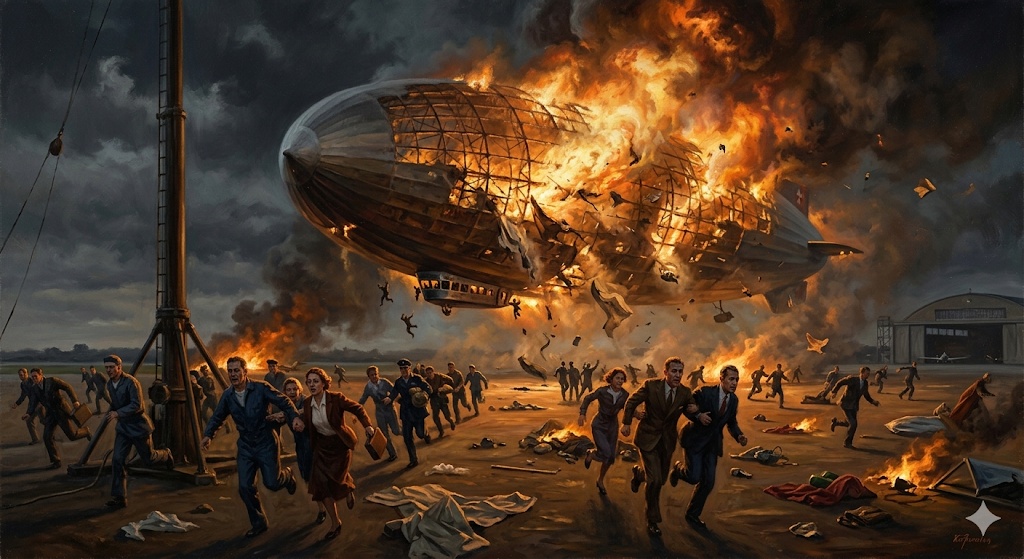
This oil painting captures the tragic Hindenburg disaster, which occurred on May 6, 1937. It depicts the exact moment the German airship LZ 129 Hindenburg erupted into a spectacular inferno while attempting to dock at Naval Air Station Lakehurst in New Jersey.
The Hindenburg Disaster: May 6, 1937
On the early evening of May 6, 1937, the massive German passenger airship LZ 129 Hindenburg was destroyed by fire during its landing at the Naval Air Station Lakehurst. After completing a transatlantic voyage from Frankfurt, the hydrogen-filled zeppelin was approaching its mooring mast when a sudden fire broke out near the tail. In less than a minute, the entire structure—spanning over 800 feet—was engulfed in flames and crashed to the ground. Of the 97 passengers and crew on board, 35 lost their lives, along with one member of the ground crew. The disaster was witnessed by a crowd of spectators and captured in iconic newsreel footage, as well as an emotionally charged radio broadcast by reporter Herbert Morrison, whose cry of “Oh, the humanity!” remains one of the most famous moments in broadcast history.
Historical Impact and Legacy
The destruction of the Hindenburg served as the definitive death knell for the era of the rigid commercial airship. Before this event, zeppelins were considered the pinnacle of luxury and the future of intercontinental travel; however, the horrific and highly publicized nature of the fire shattered public confidence in hydrogen-filled vessels. The disaster forced the global aviation industry to pivot toward the development of faster, safer, and more efficient fixed-wing aircraft, which soon came to dominate the skies. Beyond its technological impact, the image of the burning Hindenburg has become a permanent fixture in collective historical memory, symbolizing the end of an ambitious but fundamentally flawed chapter in aeronautical engineering.