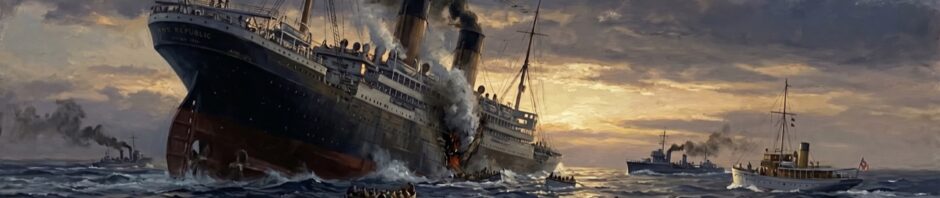
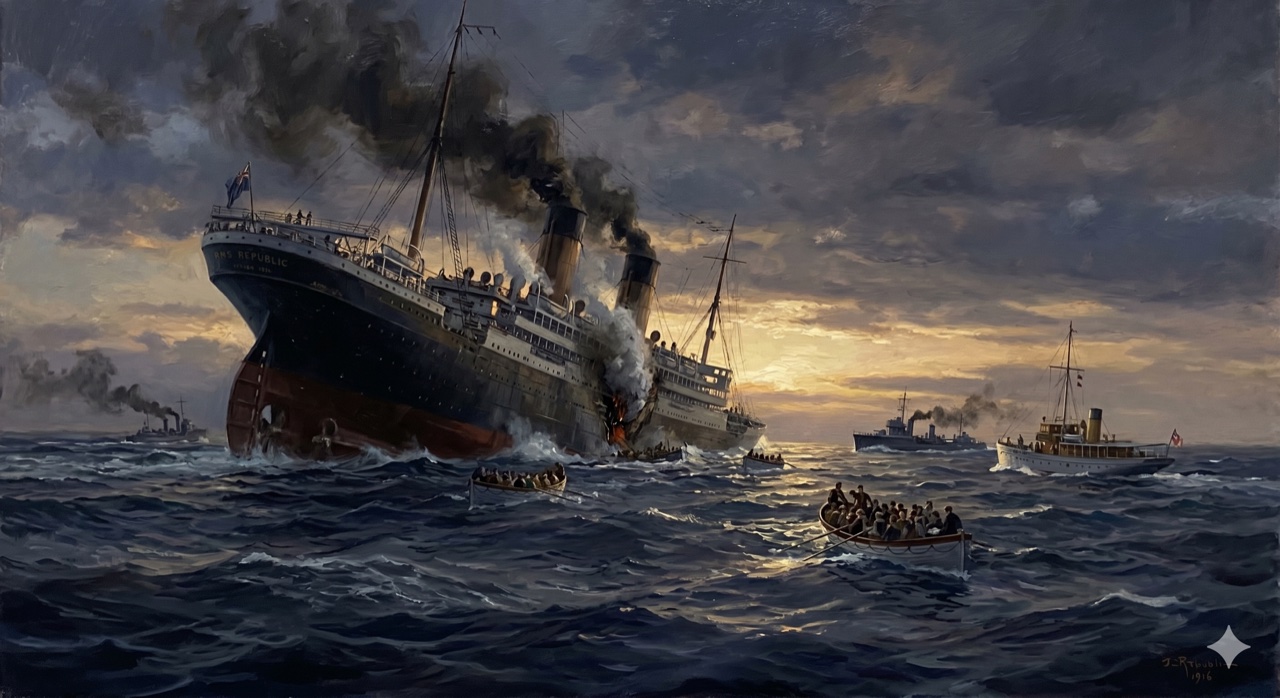
It is April 24th, 2026. For today’s entry, we examine a pivotal moment of World War I, where a maritime tragedy in the Mediterranean changed the course of naval warfare.1. The Sinking of the RMS Republic (April 24, 1916) A realistic oil painting rendering of the RMS Republic in its final moments.
The Event:
On April 24, 1916, during the height of World War I, the RMS Republic, a prominent British ocean liner requisitioned as a troopship, was sunk in the Mediterranean Sea. The Republic was en route from Alexandria, Egypt, to Marseille, France, transporting over 2,000 personnel, including the 2nd Battalion of the Royal Munster Fusiliers. Approximately 140 miles east of Malta, she was struck by a single torpedo fired by the German submarine U-34. Despite rescue efforts, the ship sank rapidly, resulting in the tragic loss of over 700 lives, making it one of the most significant maritime disasters of the Mediterranean theater during the Great War.
The Impact:
The sinking of the Republic sent shockwaves through the Allied powers, highlighting the increasing lethality of unrestricted submarine warfare in the Mediterranean, a crucial supply route for the Gallipoli campaign and the Salonika Front. The tragedy underscored the vulnerability of even heavily escorted troop transports. Following the disaster, the Royal Navy and Allied commands drastically intensified anti-submarine measures, increasing destroyer escorts, expanding the use of convoys, and accelerating the development of hydrophones and early depth charges. The immense loss of life deeply impacted the war effort and served as a stark reminder of the deadly reach of the U-boat threat.