The Isolation of Radium (April 20, 1902)
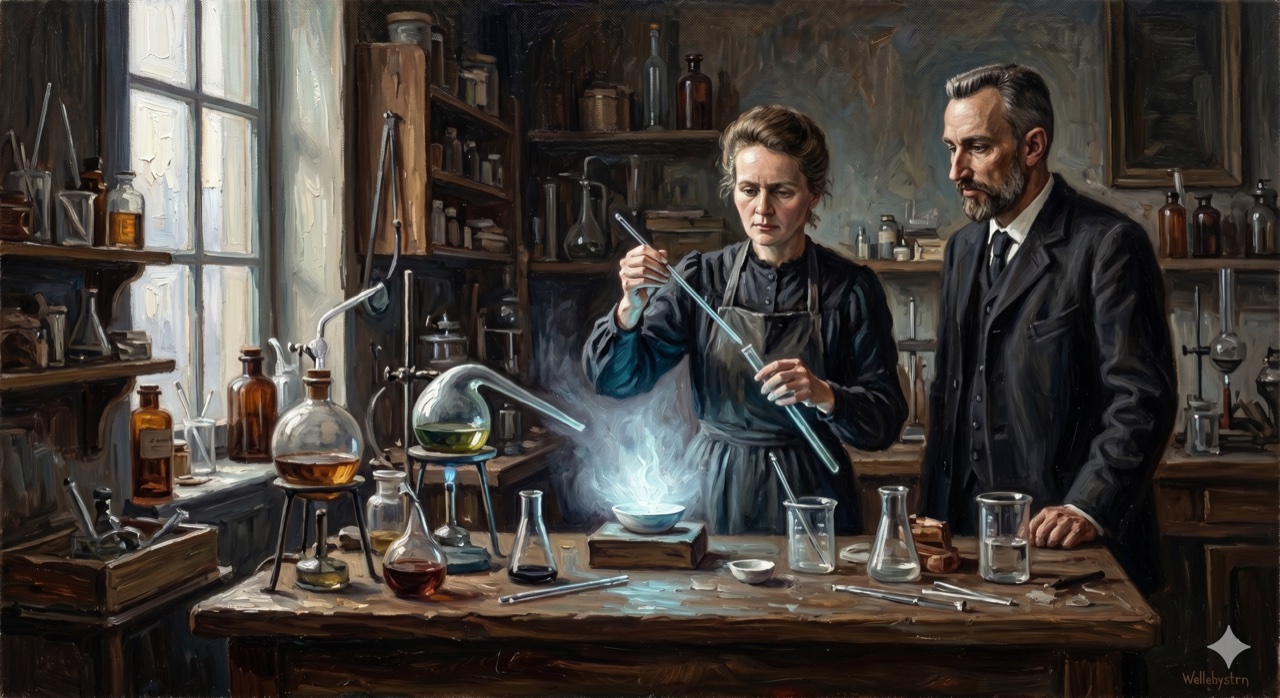
The Event: On April 20, 1902, in a leaky, makeshift laboratory in Paris, Marie and Pierre Curie successfully isolated radioactive radium salts from pitchblende. This watercolor rendering visualizes the breakthrough moment on rough paper. The scene is quiet, focused, and bathed in cool light from a large window on the left. Marie Curie, with dark hair and a heavy apron, is depicted using transparent gray and sepia washes, carefully manipulating evaporating dishes and a glass rod. Pierre Curie stands beside her, his figure defined by soft blue and brown washes, observing intently. A subtle, ethereal pale blue glow, suggested by wet-on-wet watercolor bleeding, emanates from a tiny dish on the central workbench, illuminating the surrounding glass beakers, scientific apparatus, and the clutter of their research.
The Impact: The isolation of radium was a monumental achievement that transformed physics and chemistry. It confirmed the existence of a new element and provided definitive proof of radioactivity as an atomic property. For this work, the Curies were awarded the Nobel Prize in Physics in 1903 (sharing it with Henri Becquerel), and Marie later received the Nobel Prize in Chemistry in 1911. The discovery had profound implications: it revolutionized our understanding of atomic structure, led to the development of radiotherapy for treating cancer, and opened the door to the nuclear age. Radium’s powerful, luminous glow became a symbol of early 20th-century scientific optimism, though its tragic health effects later highlighted the hidden dangers of the atomic frontier.