
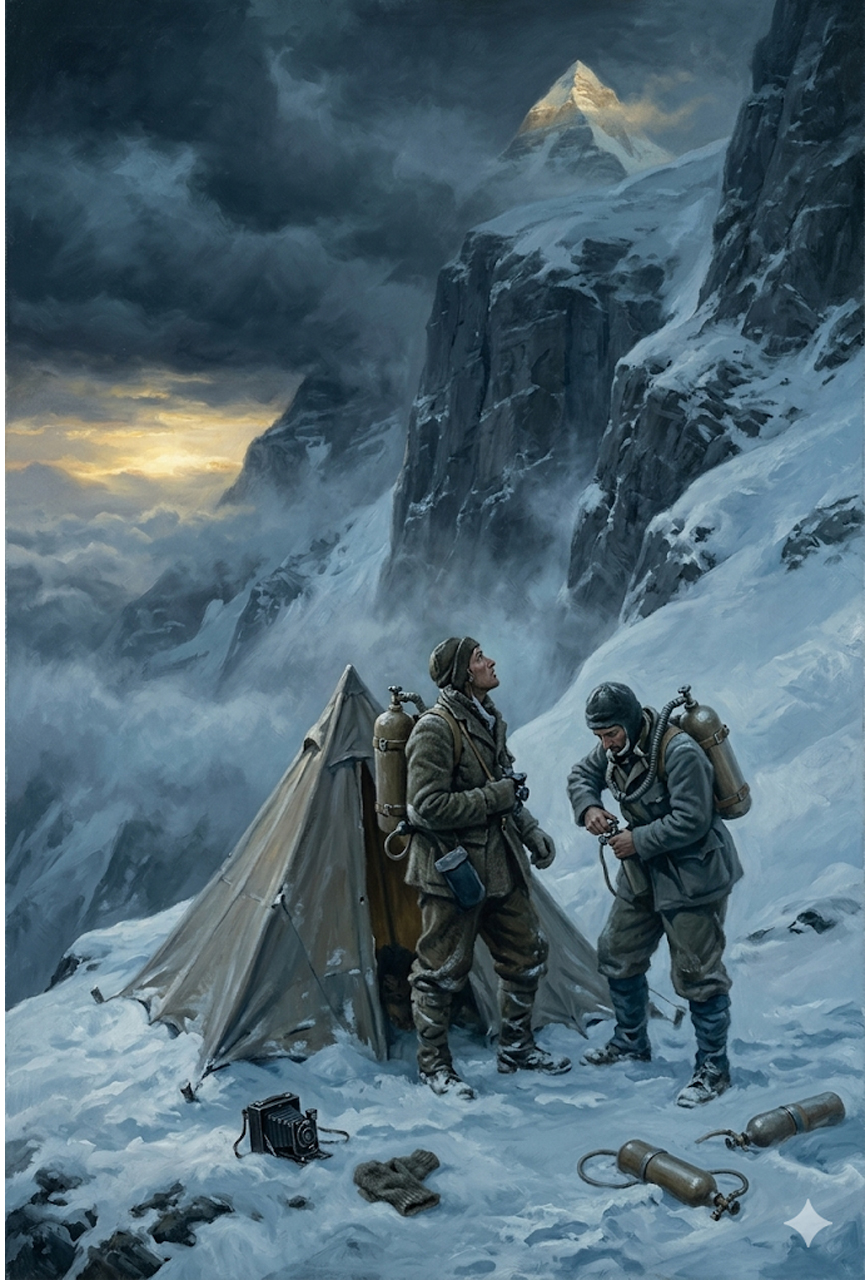
The Event: This vertical oil painting, rendered in a realistic, academic style with a somber palette of deep icy blues and cool greys, visualizes the hypothetical final attempt of the 1924 British Mount Everest expedition. Two figures, heavily bundled in primitive, layered tweed clothing and carrying cumbersome, archaic oxygen apparatus, huddle near a tiny canvas pyramid tent set precariousely on a snowy ridge. The view is focused upward, dominated by the formidable, vertical rock face known as the ‘Second Step,’ which Mallory and Irvine needed to conquer to reach the summit. A storm approaches from the upper left, while a final, weak golden light from the setting sun illuminates the summit pyramid in the distant upper center, creating a profound sense of isolation and overwhelming challenge. Scattered items—an ancient camera, a wool hat, and primitive oxygen bottles—lie discarded in the foreground snow, symbolizing both the historical mystery of their final ascent and the bone-chilling cold that defined the expedition.
The Impact: The 1924 expedition led by George Mallory and Andrew Irvine is one of the foundational myths of mountaineering and 20th-century exploration. Their disappearance on June 8th, just hundred of vertical feet from the summit, created an enduring mystery: did they actually reach the top, 29 years before Sir Edmund Hillary and Tenzing Norgay? When asked why he wanted to climb Everest, Mallory’s famously succinct reply, “Because it is there,” became the mantra for the adventurous spirit of an era seeking to define the ‘great unknown.’ The mission, framed as a last great ‘Imperial’ ambition after the trauma of World War I, cemented the idea of Everest as the “Third Pole” and a ultimate test of human endurance. The search for Mallory’s body and the subsequent discovery of some of his artifacts (including his camera, which potentially contains the proof of success) keep their tragic story and the question of first summit alive. Their attempt not only marked the beginning of high-altitude physiological study but also solidified Everest’s unique position as both a relentless challenge to human ego.